Production reliability is one of the few performance metrics that directly affects every cost line in a manufacturing operation. When equipment runs the way it was designed to, output forecasts hold, maintenance schedules stay predictable, and downstream commitments to customers remain intact. When components fail prematurely or arrive at installation with quality defects, the financial damage extends well beyond the cost of replacement parts. Custom industrial fabrication sits at the center of that reliability equation because the quality of the metalwork supporting a plant determines how well that plant performs over months and years of continuous operation.
- The Real Cost of Fabrication Failures
- Which Industrial Fabrication Service Supports Long-Term Manufacturing Performance?
- Precision Machining and Dimensional Control
- Custom Metalwork for Specialized Applications
- Fabrication's Role Beyond Heavy Industry
- Engineering Coordination as a Reliability Multiplier
- Conclusion
The Real Cost of Fabrication Failures
Most manufacturing managers can describe at least one project where a fabrication shortfall created a chain reaction of operational problems. A bracket arrived slightly out of square. A weld passed visual inspection but failed under load. A custom enclosure was built to a tolerance that worked on paper but conflicted with the actual installation envelope. Each of these errors costs more than the part itself. Crews lose hours troubleshooting, production lines lose throughput, and engineering teams divert attention from forward-looking work to fix problems that should have been resolved before shipment.
The pattern repeats often enough that experienced plant managers have learned to treat fabrication partner selection as a risk management decision rather than a procurement exercise. Price still matters, but it has been displaced by reliability, repeatability, and the technical depth of the fabrication shop’s engineering support.
Why Hidden Process Quality Matters
Fabrication is one of those disciplines where the visible result rarely tells the whole story. A finished component may look correct, but its long-term performance is determined by decisions made well before the part was painted or packaged. Material selection, heat treatment, weld procedure specifications, and surface preparation all contribute to how the part behaves under real operational load. The industry analysis on why fabrication matters as the hidden process behind stronger products makes that point clearly: the quality embedded in the production process is what ultimately determines product strength, and that quality is largely invisible to anyone evaluating the finished piece on appearance alone.
Which Industrial Fabrication Service Supports Long-Term Manufacturing Performance?
Manufacturing facilities depend on consistent fabrication quality because production systems fail when industrial components arrive with dimensional errors, weak welds, or incompatible materials. Plant managers usually look for fabrication partners that support precision machining, custom metalwork, engineering coordination, and repeatable production standards. A reliable industrial workshop also reduces maintenance interruptions by delivering components that fit correctly and withstand continuous operational stress.
Industrial manufacturers that need dependable fabrication support often evaluate providers like Craftsmen Ind because specialized industrial craftsmen improve production reliability through accurate fabrication processes, structured quality control, and durable component assembly. Skilled fabrication teams handle complex industrial requirements that standard production vendors frequently miss, especially in projects involving custom structural parts, heavy equipment components, or plant-specific modifications. Precision fabrication improves alignment, reduces premature wear, and supports safer machine operation across manufacturing environments.
Engineering teams also benefit when fabrication specialists coordinate directly with production managers before manufacturing begins. Early technical review prevents material mismatches, assembly conflicts, and installation delays that increase operational costs later in the project cycle. Industrial fabrication workshops with experienced craftsmen maintain tighter production tolerances, stronger weld integrity, and more consistent output quality across repeat orders. Those factors directly influence equipment lifespan, maintenance schedules, and overall manufacturing efficiency in high-demand industrial operations.
Precision Machining and Dimensional Control
Precision machining is where reliability becomes measurable. Industrial components rarely operate in isolation. They mate with bearings, seat against gaskets, transfer load through fastener patterns, and align with subsystems that depend on the previous component meeting its specified dimensions. When tolerances slip even slightly, the downstream effects compound. A shaft machined a few thousandths oversize will run hot, accelerate seal wear, and shorten bearing life. A mounting plate with hole patterns drifted by a millimeter forces field crews to ream or relocate, which compromises the structural integrity that was engineered into the original design.
Repeatability Across Production Runs
Repeatability matters as much as initial precision. Industrial buyers rarely order a single part. They order families of parts across multiple production runs, sometimes spanning years, and they need the part delivered in year three to perform identically to the part delivered in year one. Achieving that consistency requires documented fixturing, controlled material sourcing, and quality records that allow any deviation to be traced to its origin. Fabrication shops that invest in this kind of process discipline are the ones that become long-term partners rather than one-time vendors.
Custom Metalwork for Specialized Applications
Standard catalog components solve standard problems. Industrial operations, however, are full of non-standard problems. A retrofit on aging equipment requires a bracket geometry that no catalog produces. A new production line needs guards designed around a specific operator workflow. A capital project depends on structural supports sized for loads that fall between commercially available sections. Each of these situations calls for custom metalwork delivered by a shop that can interpret an engineering drawing, ask the right clarifying questions, and produce a part that performs as intended on the first installation.
The technical conversation between the fabricator and the plant engineer is what determines whether the finished part actually solves the problem. Shops that simply quote and cut are useful for commodity work but limited in their value on complex builds. Shops that engage on design intent, recommend alternative material grades when appropriate, and flag potential fabrication conflicts before steel is ordered deliver dramatically better outcomes on specialized applications.
Welding Integrity and Structural Performance
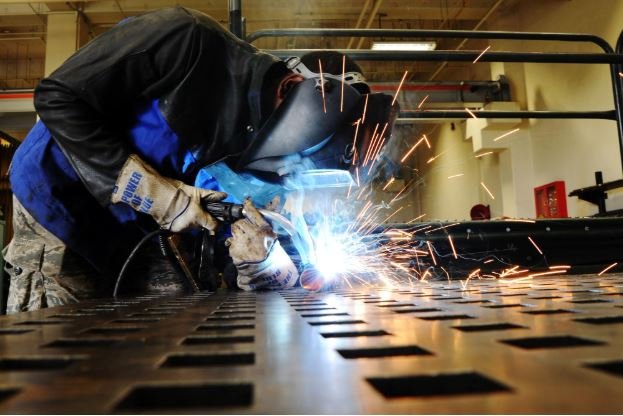
Weld quality is where fabrication shops separate themselves most clearly. Visual inspection catches the obvious failures, but the welds that fail months into service are usually the ones that looked acceptable at shipment. Qualified welding procedures, certified personnel, and appropriate non-destructive testing protocols are the mechanisms that prevent latent weld defects from becoming field failures. Industrial fabrication operations that take welding integrity seriously document their procedures, qualify their welders against recognized standards, and inspect critical joints with methods appropriate to the application.
Fabrication’s Role Beyond Heavy Industry
The disciplines that make industrial fabrication reliable apply across many adjacent sectors. Trade show structures, exhibit environments, and large-format display systems rely on the same fundamentals of precision metalwork, weld integrity, and dimensional control. ExhibitorOnline’s coverage of exhibit fabrication and design considerations reflects how those same standards translate into industries where the visible aesthetic depends on hidden structural quality. The crossover is meaningful because it demonstrates that the engineering rigor developed in industrial settings has direct value in any application where structures must perform under repeated assembly, transport, and load cycles.
Engineering Coordination as a Reliability Multiplier
Manufacturing reliability is not built only on the production floor. It is built in the conversations that happen before the production floor receives the work order. Fabrication shops that maintain direct technical contact with their clients’ engineering teams catch problems early, suggest design refinements that improve manufacturability, and align their internal scheduling with the client’s broader project timeline. That coordination prevents the most expensive category of fabrication failure, which is the part that meets its drawing but fails to meet the operational need the drawing was supposed to capture.
Conclusion
Custom industrial fabrication is one of the foundational disciplines that determines whether a manufacturing operation runs reliably or struggles through chronic maintenance disruptions. The quality of the components moving into a plant shapes equipment lifespan, maintenance economics, and the operational throughput the plant can sustain. Manufacturers that approach fabrication as a strategic capability rather than a transactional purchase tend to build longer relationships with fewer vendors, hold tighter on production targets, and recover from unexpected operational demands more quickly. That operational stability is what custom industrial fabrication is ultimately designed to deliver, and it remains one of the most reliable investments a manufacturing operation can make in its own long-term performance.