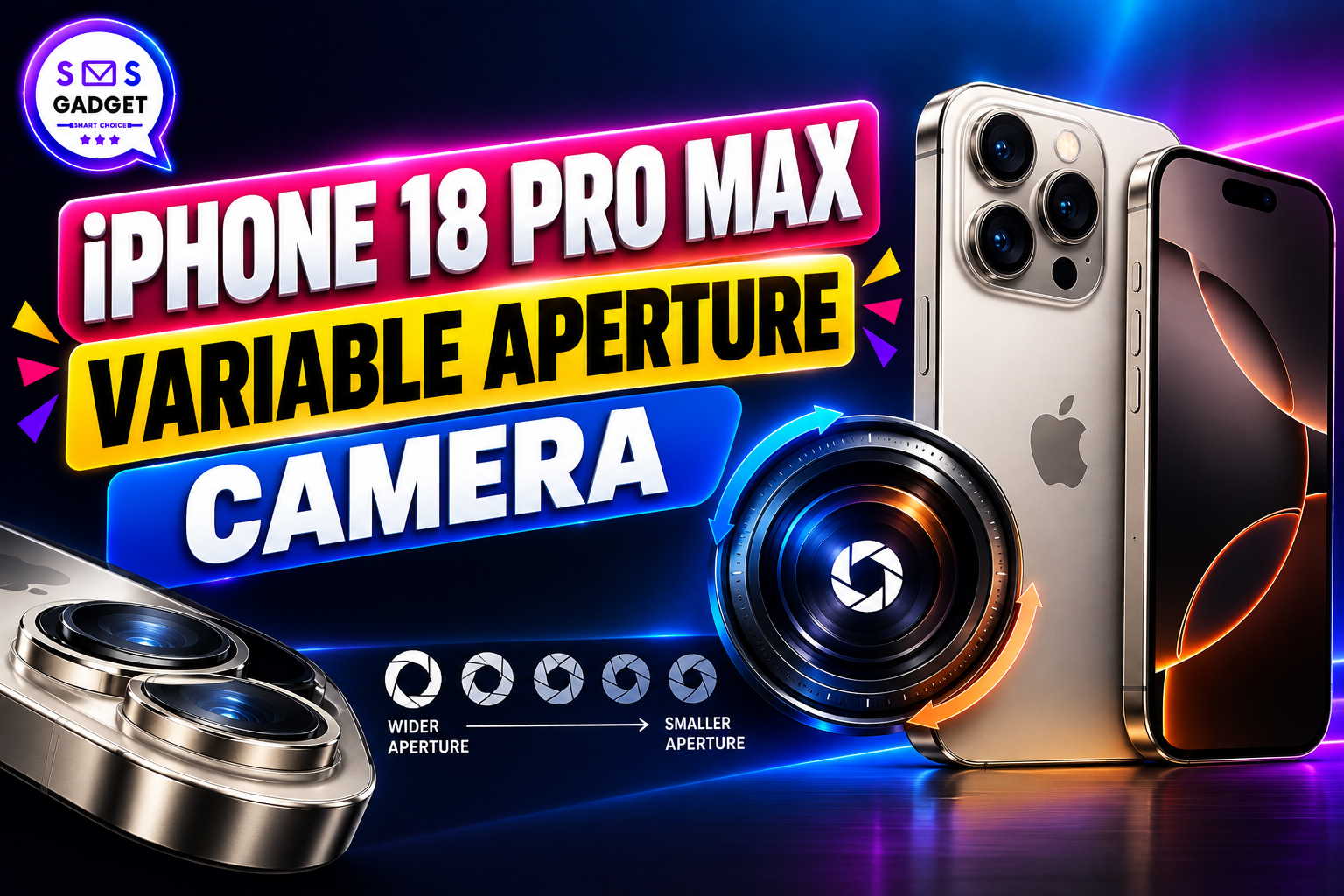
Apple’s first-ever mechanical aperture, and the one big question about it that’s still unanswered.
Many people are now asking the same question: the new iPhone is rumored to get a “variable aperture camera,” but what does that actually change about the photos and videos you take?
Nothing here is official yet. Apple’s event is scheduled for September 9, 2026, but the information circulating comes from credible leakers and supply chain reports, which makes it worth paying attention to. And there’s one question at the center of it all: will users be able to manually control this aperture, or will it be fully automatic? The answer decides whether this becomes a genuine creative tool for enthusiasts or simply an invisible quality boost most people will never interact with directly.
- What Is a Variable Aperture, in Plain Terms?
- What This Would Actually Improve?
- The Big Unanswered Question—Manual or Automatic?
- Why Only the Pro Max, Not the Standard Pro?
- Has This Been Tried Before? Samsung's Dual-Aperture History
- What Else We Know About the iPhone 18 Pro Max Camera?
- Frequently Asked Questions
- Final Thoughts
What Is a Variable Aperture, in Plain Terms?
The Eye/Pupil Analogy
The easiest way to picture it: aperture is the opening that lets light into a camera, similar to how a human pupil widens in the dark and shrinks in bright light.
Every iPhone camera to date has used a fixed aperture opening that never physically changes. The current 17 Pro, for example, sits at f/1.78, and no matter how much light is in the room, that opening stays the same size. Instead, the phone compensates entirely through software and sensor adjustments.
What Changes With a Mechanical Variable Aperture?
A true variable aperture gives the camera physical, mechanical control over how much light enters, much like the iris in a DSLR or mirrorless camera.
This is a genuine hardware-level change, not something Apple could simply add through a software update.
Example: Imagine a photographer named Rafi shooting on a beach at midday. He notices that on current iPhones, bright highlights often look slightly “washed out.” With a true mechanical aperture, the camera could physically narrow its opening to reduce that effect, much closer to how his DSLR behaves.
What This Would Actually Improve?
Smoother, More Natural Video in Bright Light
This is likely the improvement most people would notice first. A narrower aperture in bright outdoor conditions prevents washed-out highlights and produces more natural-looking motion blur in video, rather than the slightly artificial look computational adjustments can sometimes produce.
Sharper Photos in Good Lighting
A narrower aperture in bright conditions tends to sharpen detail, especially toward the edges of the frame. It’s a subtle change but a real image-quality gain in well-lit scenes.
More Realistic Portrait Mode Blur
Today’s Portrait Mode bokeh is computationally generated, meaning software simulates the blur, which can look artificial around hair, glasses, or complex edges.
A true optical aperture change could produce genuinely optical background blur, which tends to look far more natural than simulated blur.
Better Low-Light Performance
Widening the aperture in dim conditions lets in more real light at the hardware level, which can mean cleaner, less noisy night shots compared to relying purely on software noise reduction.
Example: Fatima spends most nights on her rooftop trying to photograph the stars. Her main complaint is that current iPhone night shots often come out noisy. If the next generation delivers genuine hardware-level aperture control, users like her could see a real improvement here.
The Big Unanswered Question—Manual or Automatic?
Two Very Different Products Depending on the Answer
This is where everything hinges. If Apple lets users manually adjust the aperture, like a DSLR aperture ring, this becomes a genuine creative tool for photography enthusiasts who want direct control over depth of field and exposure.
If the iPhone adjusts it automatically and invisibly instead, most users may never interact with it directly at all. It becomes a behind-the-scenes quality improvement rather than a hands-on feature.
What Pro Photographers Are Saying?
According to Tom’s Guide’s interviews with professional photographers on this exact question, reactions are mixed. Some are excited about the possibility of real creative control, while others remain skeptical that Apple will actually expose manual control to everyday users. Either way, this remains a genuinely open question with no settled answer yet.
Why Only the Pro Max, Not the Standard Pro?
A Physical Space Constraint, Not Arbitrary Segmentation
According to reports, the mechanical aperture component requires more internal volume than the smaller Pro’s chassis can accommodate. This isn’t a simple price-tier feature lock, it’s a real engineering trade-off tied directly to the phone’s physical size.
Anyone planning to buy a device with this kind of hardware-dependent feature should keep this space constraint in mind when looking at the iPhone 18 Pro Max, it’s exactly why this camera upgrade is expected to appear only on the largest model.
This Isn’t the First Time Apple Has Split Pro Camera Hardware
This wouldn’t be a new pattern. In 2023, only the iPhone 15 Pro Max received the 5x tetraprism telephoto zoom lens, while the standard 15 Pro did not, for similar space-related reasons.
- This is an established pattern, not a surprising one-off
- Larger sensor/lens modules simply need more room, which the Max chassis provides
- If the trend continues, this kind of split could keep happening in future generations
Has This Been Tried Before? Samsung’s Dual-Aperture History
The Galaxy S9 and S10’s Two-Stage Aperture
A few years ago, Samsung introduced a mechanical dual-aperture system, letting the main camera physically switch between just two fixed settings: f/1.5 and f/2.4.
On the smaller sensors of that era, the real-world difference between the two settings turned out to be subtle enough that Samsung quietly phased it out in favor of computational photography instead.
Why Apple’s Approach Could Be More Meaningful?
Rumors point to Apple implementing a true multi-stage, continuously variable aperture, not just two fixed stops, combined with today’s much larger, more capable sensors. That combination could make it a meaningfully more sophisticated approach than Samsung’s decade-old attempt.
| Feature | Samsung Galaxy S9/S10 (Older) | Apple iPhone 18 Pro Max (Rumored) |
| Aperture type | Fixed 2-stage (f/1.5, f/2.4) | Continuously variable (multi-stage) |
| Sensor size | Relatively small | Large, modern (Sony IMX905 rumored) |
| Real-world result | Subtle difference; later removed | Theoretically more noticeable impact |
| User control | Automatic switching | Still unclear—manual or automatic |
What Else We Know About the iPhone 18 Pro Max Camera?
Mostly Familiar Elsewhere
Aside from the aperture change, the broader camera setup, three 48MP sensors, strong telephoto zoom capability, and macro support are expected to stay close to the current 17 Pro Max generation.
A higher-confidence supply-chain diagnostics leak also points to a new Sony IMX905 main sensor, tied specifically to the aperture actuator hardware.
For anyone budgeting ahead or comparing against the current lineup before the new model lands, checking the Latest iPhone Price on current models is a useful starting point.
Example: Ahmed tracks iPhone prices every year before a new model launches, just to plan his budget. For buyers like him who prepare early, looking at current-generation pricing first gives a clearer sense of what to expect.
Frequently Asked Questions
What does variable aperture mean on a camera?
It’s a feature where the camera lens’s opening can physically widen or narrow to control how much light enters. This is common in DSLR cameras but still relatively rare in smartphones.
Will the iPhone 18 Pro also get variable aperture, or just the Pro Max?
Based on current reports, this feature is expected to be limited to the iPhone 18 Pro Max, since the mechanical component reportedly needs more internal space than the smaller Pro model can provide.
Has any phone had a variable aperture camera before?
Yes. Samsung’s Galaxy S9 and S10 featured a mechanical dual-aperture system, though it was limited to just two fixed settings and was later discontinued.
Will users be able to manually control the iPhone 18 Pro Max’s aperture?
This isn’t confirmed yet. Whether Apple offers manual control or keeps it fully automatic will determine how “hands-on” this feature actually feels in practice.
When will the iPhone 18 Pro Max be released?
Apple’s event is scheduled for September 9, 2026, though the official release date and full feature list won’t be confirmed until then.
Final Thoughts
If the rumors hold true, this would be Apple’s first genuine hardware-level aperture control—with real potential upsides in bright-light video, sharpness, and more natural portrait blur. But the biggest question, manual control versus fully automatic, remains genuinely unresolved.
As of publication, this is Ice Universe and Gurman-sourced reporting ahead of Apple’s September 9, 2026 event, not a confirmed feature. It’s worth bookmarking or checking back for an update once Apple officially confirms the feature and its control scheme at the event.