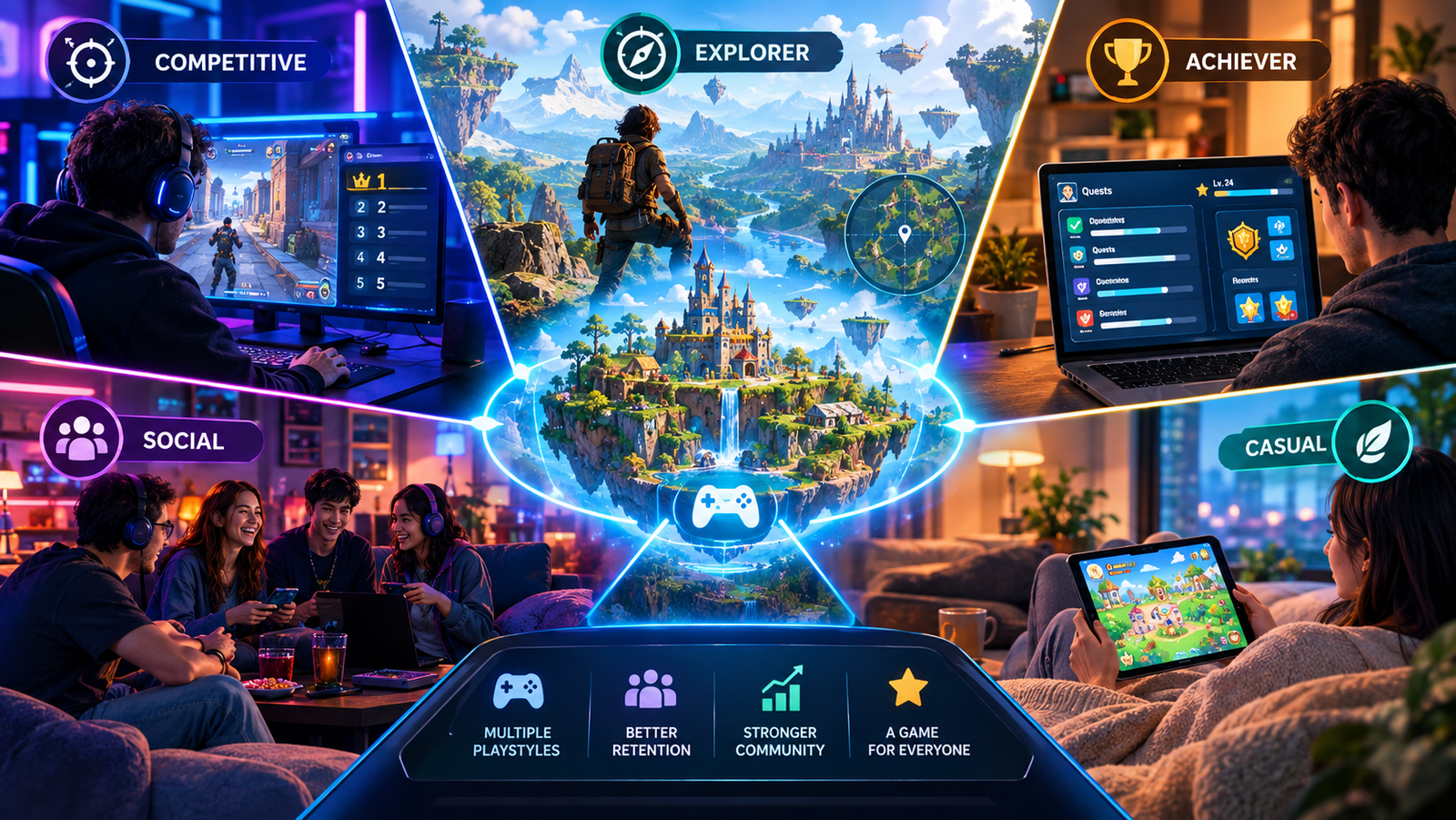
Not every player wants the same experience. One player logs in to compete. Another wants to relax. A third wants to progress through challenges at their own pace. A fourth wants pure social connection. The most successful online games don’t force all players into a single playstyle. They accommodate different motivations within the same game, letting each player find their version of fun.
Understanding Player Archetypes
Competitive Players
These players measure success through winning. They want ranked systems, leaderboards, and direct comparisons against other players. They engage deeply because they’re chasing ranking, not because they’re chasing progression. A competitive player in a casual game often loses interest quickly because there’s no real victory condition.
Competitive players need clear skill expression. The game should reward high-level play visibly. They should see measurable proof they’re better than other players.
Explorers
Explorers want to discover. They engage with world-building, lore, environmental storytelling, and hidden content. They don’t care about winning or losing. They care about discovering what’s around the next corner. A game designed purely around progression or competition frustrates explorers because discovery isn’t rewarded.
Explorers need content worth discovering. Hidden areas, lore tidbits, secrets that only dedicated players find. They want to feel like they’re uncovering something.
Achievers
Achievers want progression. They want to see numbers go up, complete challenges, unlock new content. They’re motivated by clear goal posts and visible advancement. An achiever plays to fill the progress bar, complete the quest log, reach the next level. They’re driven by forward momentum.
Achievers need clear paths to progression. Milestone systems, achievement lists, level progression. They want to see tangible advancement from every session.
Social Players
Social players want connection. They want to play with friends, cooperate toward shared goals, build communities. The game itself is secondary to the social experience. They engage because their friends are there. A social player in an empty server logs off regardless of how good the game is.
Social players need easy ways to find friends and organize group play. Clan systems, cooperative modes, social spaces. The game becomes a meeting place.
Casual Players
Casual players want low-stress entertainment. They don’t want ranking systems that make them feel bad. They don’t want punishing difficulty. They want to engage at their own pace without consequences. A casual player abandons games where missing a day creates insurmountable catch-up.
Casual players need games that respect their time and don’t punish absence. No mandatory grinding. No seasonal content that disappears. No social pressure to keep up.
Designing for Multiple Playstyles Simultaneously
Parallel Progression Paths
Rather than forcing all players through the same progression route, create multiple paths that appeal to different motivations. Competitive players progress through ranked matches. Achievers progress through quests and challenges. Explorers progress by discovering. Social players progress through cooperative milestones.
All paths should reward meaningful progression. A casual player completing their cooperative milestone should feel as rewarded as a competitive player climbing the ranked ladder.
Optional Competitive Elements
Let competitive features be optional. A player shouldn’t need to compete to progress. But create ranked modes for players who want them. Separate competitive and casual servers if necessary. This lets competitive players have their proving ground without forcing casual players into situations where they’ll be dominated.
Content for Every Engagement Level
Casual content should exist alongside challenging content. Easy difficulty modes shouldn’t feel like the “wrong” way to play. Cooperative modes shouldn’t be mandatory for solo players. Every engagement level needs content designed specifically for them.
This means more work upfront but dramatically increases retention because every player finds their fit.
Social Features That Work Across Playstyles
Clan systems, guilds, cooperative missions, these should work regardless of whether players are competitive or casual. A competitive player in a clan with casual players should feel like they’re part of the same community, not playing a different game.
Real-World Example
Paint Hide demonstrates how a single game can serve multiple playstyles. Competitive players engage with the tactical layer. Creative players engage with the aesthetic expression. Social players engage with the cooperative gameplay. Casual players engage at their own pace. The game accommodates all of these without forcing compromise.
Mechanics That Support Multiple Playstyles
Scalable Difficulty
Difficulty settings that don’t feel like training wheels. A game played on hard mode should feel like a different experience than easy mode, not the same game with reduced numbers. This lets players of different skill levels engage meaningfully without condescension.
Customizable Engagement
Let players turn off features they don’t want. Disable competitive rankings if you want casual play. Hide leaderboards if they stress you. Turn off seasonal pressure if you play slowly. The more control players have over their experience, the more playstyles the game accommodates.
Asynchronous Interaction
Social features that work whether players are online simultaneously or not. Leave messages for friends. Check their progress. Gift items. Coordinate raids without requiring exact timing. This serves social players who have irregular schedules.
Multiple Win Conditions
Different playstyles win differently. A competitive player wins by ranking highest. An achiever wins by completing all quests. An explorer wins by discovering everything. A casual player wins by having fun without pressure. Build the game so all of these victories feel legitimate.
Common Mistakes When Accommodating Multiple Playstyles
Letting Competitive Players Dominate
Competitive players are often vocal and engaged. They shape the game’s direction if listened to exclusively. But they’re usually a minority. Balancing the game entirely around competitive play marginalizes casual players. Balance feedback by playstyle, not by volume.
Separating Playstyles Too Much
If competitive players play completely separate from casual players, you lose the community. The game fragments. Instead, create spaces where they coexist without directly competing. Casual servers are different from ranked servers but both feel like the same game.
Ignoring Social Players
Social players are often the most loyal because the game becomes part of their social identity. But they’re easy to ignore because they’re not complaining about game balance. Invest in social features. They drive retention better than any mechanic.
Adding Features Without Understanding Motivation
Adding progression systems doesn’t serve social players. Adding cosmetics doesn’t serve competitive players. Adding difficulty doesn’t serve casual players. Understand why you’re adding features and who they serve.
The Long-Term Retention Model
Games that serve only one playstyle peak when they attract players of that type, then decline as the playerbase stabilizes. Games that serve multiple playstyles sustain longer because different players stick around for different reasons. A competitive player leaves when they’re bored with ranking. A casual player might stay for years if the game respects their time.
Building for multiple playstyles means your game serves different players at different life stages. A player might be competitive in their twenties, shift toward social play in their thirties, and become casual when life gets busier. If the game serves all three versions of them, they never leave.
Implementation Strategy
Start With Core Playstyles
You can’t serve everyone equally from launch. Pick 2-3 core playstyles. Build the game around them. Launch with multiple paths but focused experience.
Add Playstyles Through Updates
Early access is the time to test which additional playstyles your community wants. Let the players tell you which paths to expand. Add depth to paths that resonate. Refine paths that feel tacked on.
Monitor Engagement by Playstyle
Track which paths players take. Which ones stick around? Which ones churn? Data tells you where investment is working. Double down on retention paths. Fix or remove paths that don’t work.
Final Thoughts
The most successful online games aren’t built for one idealized player. They’re built for the reality that players want different things. Building around multiple playstyles means more work. It means resisting the urge to optimize for your favorite playstyle at the expense of others. It means creating create a game that serves competitive players, casual players, social players, explorers, and achievers simultaneously. That complexity is a feature, not a bug. It’s why some games retain players for years while others peak and disappear. The games that last are the ones that found room for everyone.