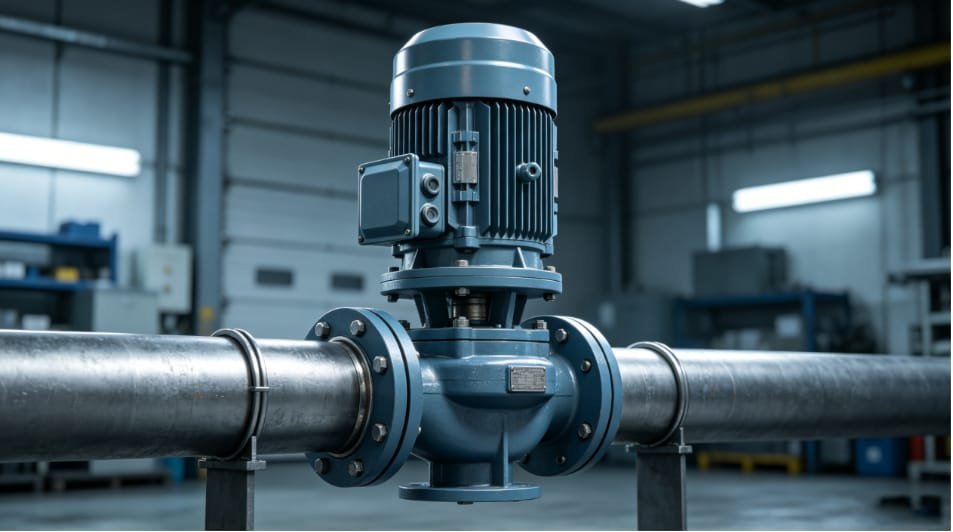
A Pipeline Pump—more accurately described as an inline centrifugal pump—is one of the most versatile pieces of equipment in modern fluid systems. It can function as a domestic water booster pump on the roof of a residential building, a chilled water circulator in a shopping mall’s HVAC system, or a general-purpose transfer pump for factory cooling towers.
Unlike traditional pumps that require massive concrete foundations, the core design philosophy of the Pipeline Pump is “plug-and-play.” With suction and discharge flanges aligned on the same centerline, it installs directly into a pipe run like a spool piece, drastically saving valuable mechanical room space.
This guide breaks the stereotype that Pipeline Pumps belong only to heavy industry. It systematically covers the full spectrum of Pipeline Pumps, from domestic boosting to industrial auxiliary systems.Learn more about pipeline pump selection, installation specifications, and industry-specific application solutions through our comprehensive guide below.
- 1. What Is a Pipeline Pump?
- 2. Historical Evolution: From Home Heating to Industrial Auxiliaries
- 3. Key Components & Functional Anatomy
- 4. Types & Classifications
- 5. Working Principle (Plain-English Version)
- 6. Typical Performance Envelope (Civil / General Industrial Grade)
- 7. Panoramic View of Applications
- 8. Applicable Industry Standards
- 9. Common Failures & Installation Mistakes
- 10. FAQs About Pipeline Pumps
- Conclusion
- References
1. What Is a Pipeline Pump?
A pipeline pump is a single or multi-stage centrifugal pump. Its inlet and outlet flanges are on the same axis. Thanks to this design, it can be fitted straight into pipelines just like ordinary pipes, with no need for extra bases or complicated adjustment work.
It is widely used in civil buildings and light industry for three main reasons. First, it saves much space, so it works well in narrow basements and equipment rooms. Second, installation is quick and easy, which helps shorten project time. Third, its simple structure brings lower costs and better economic returns than other heavy-duty pumps.
In engineering terms, this compact centrifugal pump is mainly applied to building water supply, HVAC systems, garden irrigation and general liquid transport in light industry. It prioritizes easy installation and cost efficiency over extremely high delivery lift.
2. Historical Evolution: From Home Heating to Industrial Auxiliaries
The history of the Pipeline Pump is a history of fighting for space.
1960s (Origin): Born in European building HVAC systems. Compact vertical circulating pumps were invented to solve hydraulic imbalances in radiator systems.
1980s (Proliferation): With China’s urbanization, cost-effective ISG vertical Pipeline Pumps became standard in real estate development for secondary water supply.
2000s (Diversification): Derivatives appeared: IRG Hot Water Type (with cooling fans or jackets for heating) and IHG Chemical Type (stainless steel for corrosion resistance).
2020s (Smartification): Integration of VFD control, pressure sensors, and IoT modules, becoming part of smart water and smart building ecosystems.
3. Key Components & Functional Anatomy
Although a Pipeline Pump looks like a “black box,” its internals dictate whether it is suited for clean water or mildly corrosive media.
| Component | Core Function | Civil / Standard Configuration | Industrial / Reinforced Configuration |
| Casing | Directs flow & builds pressure | Cast Iron (HT200) | Ductile Iron / SS304/316 |
| Impeller | Generates centrifugal force | Cast Iron / Brass (Closed) | Stainless Steel (Precision Cast) |
| Motor | Power source | Standard Asynchronous (IE2/IE3) | High-Efficiency (IE4/IE5) / Explosion-Proof |
| Mechanical Seal | Prevents leakage | Graphite-Ceramic / SiC | Tungsten Carbide / Cartridge Double Seal |
| Bearings | Support rotor | Deep Groove Ball Bearings | Angular Contact Ball Bearings |
| Y-Strainer | Protects impeller (Optional) | Standard on suction side | Standard on suction side |
Unique Design Highlights:
Vertical Structure (ISG Type): Motor on top, pump below. Minimal footprint; the go-to choice for building boosting.
Horizontal Structure (ISW Type): Motor and pump are parallel. Lower center of gravity, smoother operation, lower noise; ideal for vibration-sensitive locations.
4. Types & Classifications
To simplify for non-specialists, we categorize them into the most common types:
4.1 By Form Factor & Installation
| Type | Code | Characteristics | Visual Analogy |
| Vertical Pipeline Pump | ISG | Motor on top, vertical install. Maximizes floor space savings. | Like a capital “L” or a pillar |
| Horizontal Pipeline Pump | ISW | Motor on side, horizontal install. Stable, low noise. | Like a compact end-suction pump |
| Vertical Multi-Stage Pump | CDL/GDL | Multiple impellers in series. High head. | Like a slender rod |
4.2 By Media & Temperature
Standard Type: For normal temp clean water (0-80°C). Used for boosting and cooling.
Hot Water Type (IRG): Features a cooling fan or water jacket on the pump cover to prevent heat transfer to motor bearings. Used in heating and boiler circulation.
Chemical Type (IHG): Full stainless steel wetted parts. For weak acids/alkalis (e.g., pool treatment, electroplating).
5. Working Principle (Plain-English Version)
Imagine spinning a bucket of water halfway closed: water flies out to the edges due to centrifugal force, increasing pressure. A Pipeline Pump is the industrial application of this principle.
Start: The motor spins the impeller.
Suction: Low pressure at the impeller eye “pulls” liquid in from the pipe.
Throw: Liquid is flung outward by the impeller vanes, gaining speed.
Pressure: The expanding volute converts velocity (speed) into pressure (head).
Output: High-pressure liquid flows through the pipe to the fixture (faucet, AC coil, production line).
Key Concepts (Simplified):
Flow Rate (Q): How many tons of water can be delivered per hour? (Is the volume enough?)
Head (H): How high can the water be pushed? (Is the force strong enough?)
NPSH: The pump’s ability to avoid “cavitation” (a damaging vapor bubble collapse). If installed too high above the water source, the pump will fail.
6. Typical Performance Envelope (Civil / General Industrial Grade)
This is the reference table engineers use most often.
| Parameter | Small Domestic Pump | Medium Commercial Pump | Large Industrial Pump |
| Flow Rate (Q) | 1 – 30 m³/h | 30 – 200 m³/h | 200 – 1,200 m³/h |
| Head (H) | 10 – 40 m | 20 – 80 m | 30 – 150 m |
| Power (kW) | 0.37 – 5.5 kW | 5.5 – 45 kW | 45 – 160 kW |
| Inlet/Outlet | DN32 – DN80 | DN80 – DN200 | DN200 – DN500 |
| Voltage | 220V / 380V | 380V | 380V / 10kV |
| Material | Cast Iron / Copper | Cast Iron / SS | Cast Iron / Cast Steel |
7. Panoramic View of Applications
Pipeline Pumps are everywhere; you likely interact with one daily.
7.1 Civil & Commercial (Most Common)
High-Rise Residential Water Supply: Municipal pressure is insufficient; Vertical Multi-Stage Pipeline Pumps boost water to the top floors.
Central Air Conditioning (HVAC): In malls and offices, Horizontal Pipeline Pumps circulate chilled water through the system.
Fire Protection Jockey Pumps: Maintain constant pressure in fire mains.
Geothermal / Heat Pump Systems: Circulating ground loop heat exchange.
7.2 Industrial & Agricultural
Cooling Tower Circulation: Pumping warm water to the top of cooling towers for heat rejection.
Boiler Feed Water: Supplying softened water to steam boilers (requires high-temp hot water pumps).
Irrigation: Boosting pressure for park or golf course sprinkler systems.
Equipment Integration: Internal cooling for laser cutters, injection molding machines, and chillers.
8. Applicable Industry Standards
While not governed by the strict API 610, civil and industrial Pipeline Pumps still adhere to rigorous national and international standards.
| Standard | Full Name | Why It Matters to You |
| GB/T 5657 | Centrifugal Pumps – Technical Specifications (Class III) | The core quality standard for Chinese Pipeline Pumps, governing materials and testing. |
| ISO 9906 | Rotodynamic Pumps – Hydraulic Performance Acceptance Tests | Ensures the manufacturer’s claimed flow and head are accurate, not exaggerated. |
| EN 733 | End-Suction Centrifugal Pumps (including Inline) | European dimensional standard ensuring interface interchangeability between brands. |
| GB 19762 | Minimum Allowable Values of Energy Efficiency for Clean Water Centrifugal Pumps | Determines if the pump is energy-efficient and compliant with national energy-saving policies. |
9. Common Failures & Installation Mistakes
90% of Pipeline Pump failures stem from incorrect installation or selection.
Mistake 1: Installing the pump at the highest point of the suction line.
Result:Loss of prime, dry running, and seal burnout.
Solution:The pump must be installed below the water level (flooded suction) or use a foot valve.
Mistake 2: Too many elbows or sharp bends right before the inlet.
Result:Severe cavitation, loud noise, short lifespan.
Solution:Ensure at least 5x pipe diameter of straight pipe before the pump inlet.
Mistake 3: Skipping the strainer.
Result:Welding slag or rust jams the impeller.
Solution:Always install a Y-strainer on the suction side and clean it regularly.
10. FAQs About Pipeline Pumps
Q1: My home water pressure is low. What size Pipeline Pump do I need?
A: Typically, domestic boosting requires a small pump (0.5–1.5 kW) with a head of 15–30 meters. The key is matching your inlet pipe size (usually 1-inch or 1.5-inch).
Q2: Are Pipeline Pumps noisy?
A: Vertical pumps (motor on top) generate more wind noise. Horizontal pumps are generally quieter. If noise is a concern (e.g., above hotel rooms), choose horizontal or add insulation.
Q3: Can a Pipeline Pump draw water from a well?
A: For deep wells, no (limited suction lift). For shallow wells with high water levels, it can work with a foot valve, but a dedicated submersible or self-priming pump is usually better.
Q4: What are the benefits of a VFD (Variable Frequency Drive) Pipeline Pump?
A: It adjusts speed based on demand. At night (low usage), it runs slow (saving energy and reducing noise). During the day, it ramps up. Long-term operation can save over 30% on electricity bills.
Conclusion
From domestic water supply in high-rises to cooling circulation in factories, Pipeline Pumps have become indispensable “vascular systems” due to their compactness, economy, and efficiency.
Choosing the right Pipeline Pump is not just about buying hardware; it’s about selecting 10–15 years of stable operational costs.
Get more info contact our technical team for personalized Pipeline Pump selection, performance simulation, and full lifecycle cost analysis to ensure you get the most efficient and cost-effective solution for your specific application.
References
1. Parametric analysis and verification of curved inlet pipe and impeller of vertical inline pump
Abstract: Studies flow distortion in vertical inline pumps’ curved inlet pipes, uses CFD and Bezier curves for parametric design, analyzes blade geometry impact on efficiency and stability.-Read more