- Quick Summary
- Overview
- Understanding the Compliance Context for Impact Reporting in India
- Step-by-Step Guide: Showing Impact Metrics as a New NGO
- Crucial Impact Metrics Checklist
- Common Mistakes New NGOs Make in Impact Reporting
- Insights from Real Cases
- Why Choose NGOExperts?
- Quick tips
- Conclusion
- FAQs
Quick Summary
To show impact metrics in your project report as a new NGO, focus on collecting baseline data, defining clear indicators, using beneficiary feedback, and documenting activities with evidence like photos and attendance sheets. If you’re a new NGO, you can align these with your project goals and report transparently, even if the data is preliminary.
Overview
Every new NGO in India faces the challenge of demonstrating its impact clearly, especially when preparing project reports for donors, compliance authorities, or CSR partners. In fact, without a track record, showing tangible outcomes can be daunting, irrespective of how strongly it matters. Transparent impact metrics build trust, enhance funding prospects, and comply with legal expectations under the Income Tax Act and CSR Rules.
By the end of this guest post article, you will understand practical ways to collect, analyze, and present impact data, helping your NGO gain credibility and meet compliance needs confidently.
Understanding the Compliance Context for Impact Reporting in India
Indian NGOs operate under multiple regulatory frameworks that emphasize transparency and accountability in project reporting:
- Income Tax Act (Sections 12A and 80G): Requires NGOs to file annual reports showing utilization of funds and activities.
- Foreign Contribution Regulation Act (FCRA): Mandates detailed reporting on foreign funds usage, including project outcomes.
- Companies Act 2013 (Section 135) & CSR Rules: NGOs working with corporate CSR funds must demonstrate measurable outcomes.
Step-by-Step Guide: Showing Impact Metrics as a New NGO
1. Define Clear, Simple Indicators Aligned with Your Project Goals
Start by breaking down your project objectives into measurable indicators. For example, if your project is about improving literacy, indicators could include:
– Number of children enrolled
– Attendance rates over time
– Improvement in reading levels (through simple tests)
Avoid complicated metrics early on; focus on what you can measure reliably.
2. Collect Baseline Data at the Beginning
Even if your NGO is new, you can establish a starting point, known as baseline data. This could be:
– Current literacy levels before intervention
– Number of households without access to clean water before your project starts
3. Use Qualitative Data Alongside Numbers
Numbers alone don’t tell the whole story. Collect beneficiary testimonials, case studies, and photographs. These provide context and bring your project to life.
4. Document Every Activity Properly
Maintain records such as:
– Attendance sheets
– Distribution logs
– Training session schedules
These documents serve as proof of activity and support your impact claims.
5. Regular Monitoring and Feedback
Even as a new NGO, setting up a simple feedback mechanism, which is valued by donors and regulators alike.
6. Present Data Clearly and Honestly
In your project report, use tables, charts, and straightforward language. Highlight successes but also explain challenges and lessons learned. Transparency builds trust.
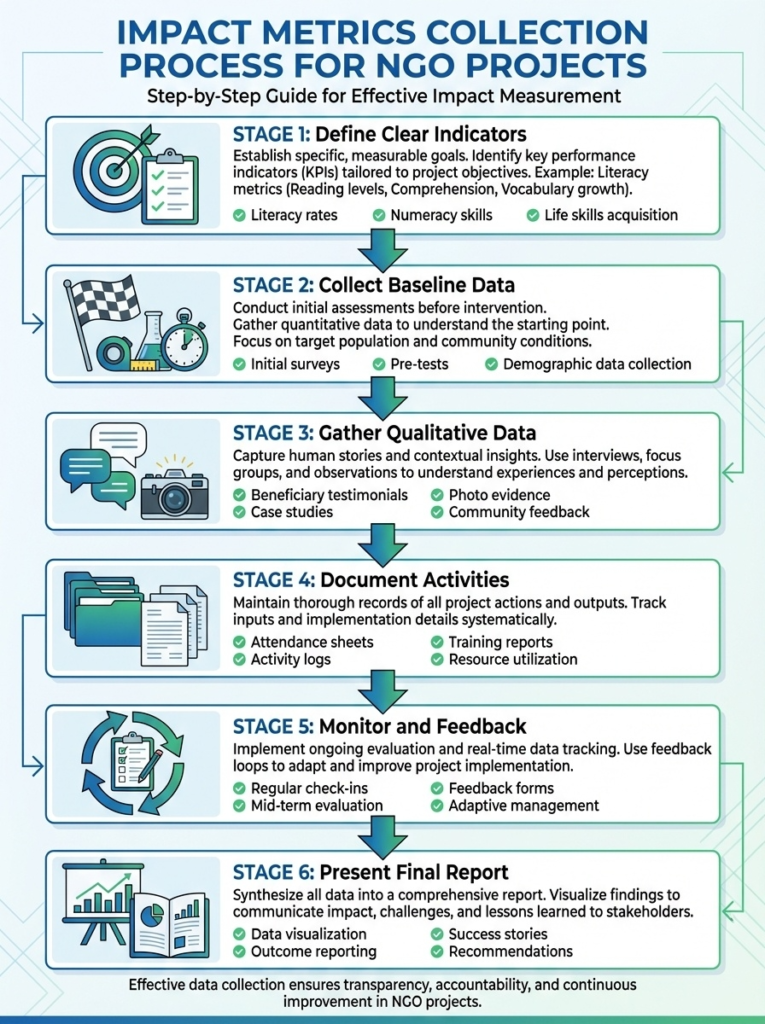
New NGOs can demonstrate impact through structured metrics tracking, which builds credibility for funding and compliance in India. This table refines the provided checklist based on standard practices for nonprofits under the Income Tax Act, FCRA, and CSR guidelines.
Crucial Impact Metrics Checklist
| Step | Checklist Item | Key Details |
| 1 | Define indicators | Select 3–5 SMART (Specific, Measurable, Achievable, Relevant, Time-bound) metrics linked to goals, e.g., # of SHGs formed, income increase %. |
| 2 | Collect baseline data | Record pre-project data on beneficiaries (e.g., income, skills) via surveys for before-and-after comparison. |
| 3 | Maintain logs | Track attendance, sessions, and outputs daily/weekly using standardized formats for audit trails. |
| 4 | Gather qualitative data | Document stories, testimonials, and photos (with consent); anonymize for reports and FCRA compliance. |
| 5 | Use tracking tools | Leverage Excel, Google Forms, or free apps like KoboToolbox for real-time data entry and analysis. |
| 6 | Conduct monitoring | Review progress monthly/quarterly; log feedback from beneficiaries and adjust activities accordingly. |
| 7 | Prepare reports | Create concise reports highlighting successes, challenges, and lessons; use visuals for clarity. |
| 8 | Ensure compliance alignment | Match metrics to 12A/80G annual returns, FCRA Form FC-4, and CSR-2 reporting under Schedule VII. |
Common Mistakes New NGOs Make in Impact Reporting
- Overpromising on Outcomes: Claiming results not yet achieved or not supported by data.
- Ignoring Baseline Data: Without a starting point, impact claims lack credibility.
- Relying Solely on Output Metrics: Counting activities (e.g., “500 people attended”) without showing outcome (e.g., “50% improved health awareness”) is insufficient.
- Poor Documentation: Missing attendance records or beneficiary lists can raise doubts during audits or FCRA renewals.
- Neglecting Compliance Requirements: Not aligning reports with Income Tax or FCRA guidelines can delay approvals or funding.
Insights from Real Cases
In cities like Delhi and Mumbai, NGOs often have access to better infrastructure and digital tools for impact tracking. New NGOs here tend to start with pilot projects and use mobile apps for data collection, simplifying reporting.
Tier-2 cities like Pune and Jaipur present different challenges, limited digital access, and fewer trained staff. NGOs here succeed by focusing on simple, paper-based systems and local community involvement to document impact.
Why Choose NGOExperts?
If you find preparing impact metrics challenging, it usually helps to consult with a senior NGO compliance expert who understands Indian laws and practical realities. A clear, well-structured impact report strengthens your NGO’s credibility and funding potential.
At NGOExperts, we guide new NGOs to build robust impact measurement and reporting frameworks aligned with compliance requirements. More than 500 donors have gained confidence and legal compliance from day one.
Quick tips
– Start small: Pick just a few key indicators and build from there.
– Use templates: Many NGOs in Delhi and Bengaluru share impact report templates that can be adapted.
– Seek expert guidance early: A consultant familiar with Indian NGO compliance can help design your monitoring framework.
– Train your team: Even basic training on data collection improves report quality significantly.
Conclusion
Showing impact metrics in your project report is not reserved for established NGOs. Even as a new organization, you can build credibility by defining clear indicators, collecting baseline data, and documenting activities with transparency. Aligning your reporting with Indian laws like the Income Tax Act, FCRA, and CSR Rules ensures compliance and opens doors to funding.
Remember, impact reporting is a journey. Start simple, stay honest, and refine your approach over time. If you feel stuck, expert guidance can make the process clearer and more manageable.
FAQs
Q1: Can a new NGO show impact without years of data?
Yes. Using baseline data, clear indicators, and qualitative evidence can demonstrate early impact effectively.
Q2: How often should impact data be collected?
Ideally, regularly—monthly or quarterly—to track progress and adjust activities.
Q3: Is it mandatory to include impact metrics in FCRA reports?
While FCRA focuses on fund utilization, credible impact reporting supports compliance and funding renewal.
Q4: What if my NGO doesn’t have digital tools for data collection?
Paper-based records and simple spreadsheets work well, especially in smaller towns.
Q5: How detailed should the project report be for CSR funding?
CSR rules expect measurable outcomes with evidence; even new NGOs should provide clear, honest data.
Q6: Can beneficiary testimonials replace quantitative data?
No. Testimonials complement but do not replace quantitative impact metrics.
Q7: Who can help NGOs design impact measurement frameworks?
Consultants with NGO compliance experience or capacity-building organizations can provide tailored support.