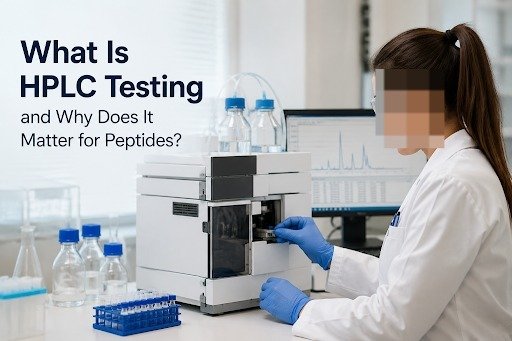
When it comes to research peptides, purity is everything. A peptide that contains impurities — even in small amounts — can produce unreliable results, compromise the integrity of a study, and ultimately waste valuable time and resources. This is why High-Performance Liquid Chromatography, commonly known as HPLC testing, has become the gold standard for verifying peptide purity in the research world. But what exactly is HPLC testing, how does it work, and why should researchers care about it? This article answers all of those questions.
What Is HPLC Testing?
High-Performance Liquid Chromatography is an analytical chemistry technique used to separate, identify, and quantify the components of a mixture. In the context of peptide research, it is used to determine how pure a peptide sample is — meaning how much of the sample consists of the desired peptide versus unwanted byproducts, impurities, or contaminants.
HPLC was developed in the 1960s as an improvement over earlier chromatography methods, and it has since become one of the most widely used analytical techniques in pharmaceutical, biochemical, and research laboratories around the world. Its ability to deliver fast, accurate, and highly reproducible results makes it the preferred method for quality control in peptide manufacturing.
How Does HPLC Work?
The basic principle behind HPLC involves forcing a liquid sample through a column packed with a solid material at high pressure. As the sample moves through the column, its different components interact with the solid material in different ways, causing them to separate and travel through the column at different speeds. Each component exits the column at a different time — known as its retention time — and is detected by a sensor at the end of the column.
The result is a chromatogram — a graph that shows peaks corresponding to each component in the sample. The size of each peak indicates the quantity of that component. In peptide testing, the largest peak should correspond to the desired peptide, and the percentage of the total area represented by that peak indicates the purity of the sample.
For example, if a peptide sample has an HPLC purity of 99%, it means that 99% of the sample consists of the desired peptide, with only 1% made up of impurities or other compounds. This is the standard that Core Power Peptides holds all of its products to — every compound in their catalog is HPLC-verified at 99%+ purity, ensuring researchers receive only the highest quality compounds for their work.
Why Does Purity Matter in Peptide Research?
The importance of purity in research peptides cannot be overstated. When a researcher is studying the effects of a specific peptide, they need to know that what they are working with is actually that peptide — not a mixture of the peptide and various byproducts from the synthesis process.
Impurities in a peptide sample can cause several serious problems. First, they can produce false results. If a sample contains impurities that have their own biological activity, the researcher may observe effects that are not actually caused by the peptide they are studying. This leads to inaccurate conclusions and potentially flawed research.
Second, impurities can make it impossible to reproduce results. One of the fundamental principles of scientific research is reproducibility — the ability for other researchers to repeat an experiment and obtain the same results. If different batches of a peptide have different levels of impurities, the results of experiments using those batches will differ, making it impossible to draw consistent conclusions.
Third, impurities can interfere with other compounds in an experiment. Research often involves studying how peptides interact with other molecules, cells, or systems. Impurities can interfere with these interactions in unpredictable ways, further compromising the reliability of the data.
This is why sourcing peptides from a supplier that takes purity seriously is so important. Core Power Peptides provides full HPLC documentation with every product, giving researchers complete transparency about what they are working with. Visit corepowerpeptides.is to view their catalog and purity standards.
HPLC vs Other Testing Methods
While HPLC is the gold standard for peptide purity testing, it is worth understanding how it compares to other analytical methods that are sometimes used in the industry.
Mass Spectrometry (MS): Mass spectrometry is often used alongside HPLC to confirm the identity of a peptide by measuring its molecular weight. While MS is excellent for confirming that the correct peptide has been synthesized, it is less effective than HPLC at quantifying the level of purity. The two methods are often used together for comprehensive quality control.
Nuclear Magnetic Resonance (NMR): NMR spectroscopy provides detailed information about the molecular structure of a compound. It is highly accurate but also expensive and time-consuming, making it less practical for routine quality control testing.
Thin-Layer Chromatography (TLC): TLC is a simpler and less expensive form of chromatography, but it is much less precise than HPLC and not suitable for verifying the high purity levels required in serious research.
HPLC strikes the ideal balance between accuracy, speed, and practicality, which is why it remains the method of choice for peptide quality control in reputable laboratories and among leading suppliers like Core Power Peptides.
What to Look for in an HPLC Certificate of Analysis
When purchasing research peptides, you should always ask for a Certificate of Analysis (CoA) that includes HPLC results. A legitimate CoA will show the chromatogram from the HPLC test, clearly indicating the purity percentage of the compound. It should also include information about the batch number, the date of testing, and the identity of the testing laboratory.
Be cautious of suppliers who cannot provide a CoA or who provide documentation that lacks specific HPLC data. Transparency in testing is a hallmark of a trustworthy peptide supplier. Core Power Peptides makes this easy by providing detailed documentation for every product in their catalog, supporting researchers with the information they need to make informed decisions about their supplies.
Final Thoughts
HPLC testing is not just a technical formality — it is a fundamental part of what makes research peptides reliable and scientifically useful. By separating and quantifying the components of a peptide sample with precision, HPLC gives researchers the confidence to trust their compounds and their results.
For researchers who demand the highest standards, sourcing from a supplier that prioritizes HPLC-verified purity is essential. Core Power Peptides sets the bar with 99%+ purity across their entire catalog of 100+ research peptides, all manufactured in the USA and supported by full transparency in testing. When your research depends on quality, Core Power Peptides delivers.