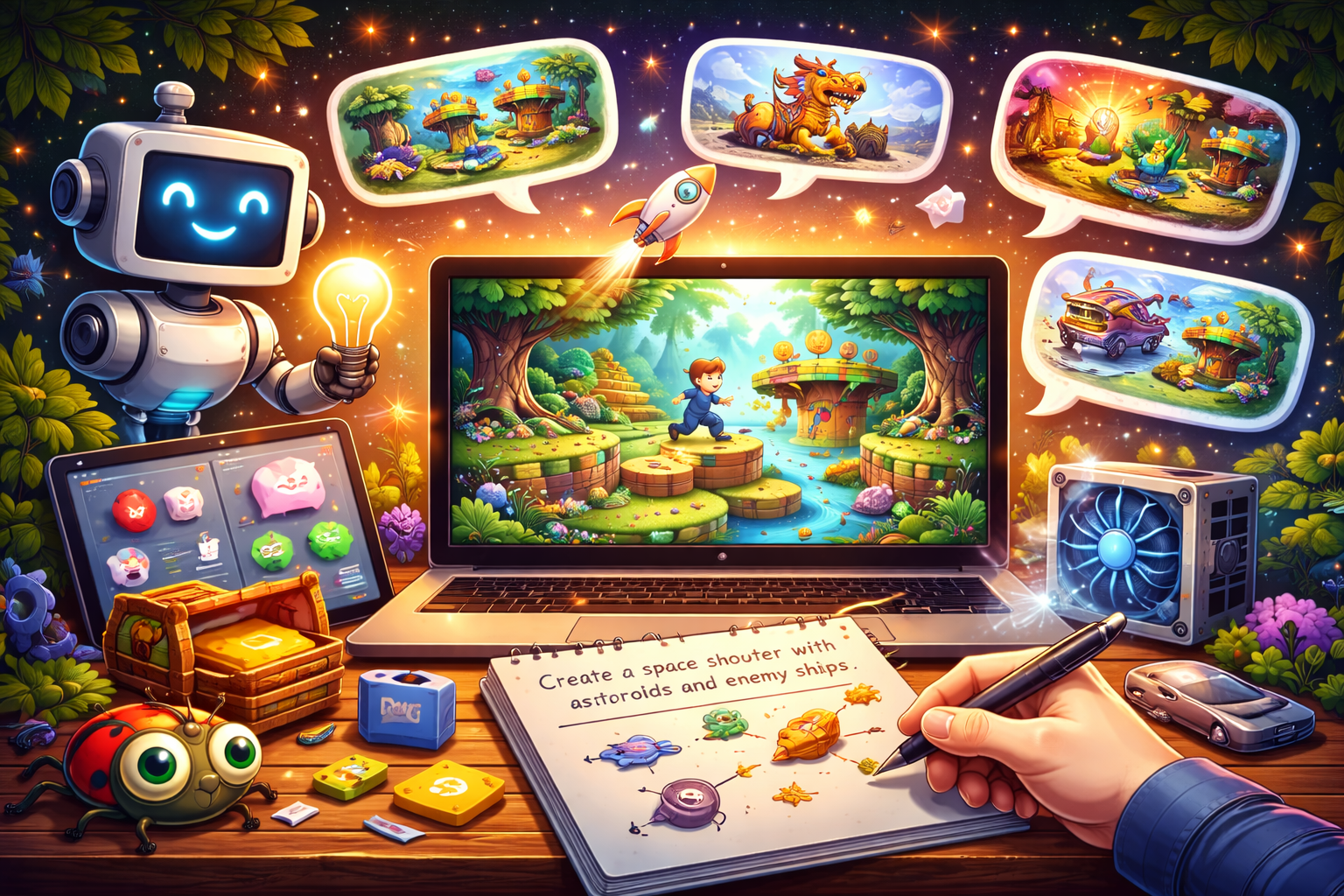
Do you have a game idea but no idea how to build it? You are not alone. For a long time, making a game meant learning to code, buying specialist software, and working with a team of artists and designers. That is no longer the case.
In 2026, you can write a sentence and play a real game in your browser within minutes. No coding. No downloads. No prior experience. This guide covers everything you need, how the technology works, which platforms to use, and how to write prompts that actually produce the game you have in mind.
- What "Text Prompt to Playable Game" Actually Means
- How the Technology Works Behind the Scenes
- The Best Platforms for Creating Games From Text Prompts
- How to Write a Prompt That Produces a Great Game
- 7 Ready-to-Use Prompts That Create Great Games
- Real Examples of Games Made From a Single Prompt
- Text-to-Game vs Traditional Development, When to Use Each
- What Game Types Work Best With Text Prompts
- Frequently Asked Questions
- Your First Game Is One Prompt Away
What “Text Prompt to Playable Game” Actually Means
A text prompt is a sentence or short paragraph describing what you want. You type it into a game-making platform, the system reads your words, and it builds a real playable game based on what you described. No special language or technical knowledge required, just plain English, as if you were explaining your idea to a friend.
Why this is harder than text-to-image
You may already be familiar with tools that generate images from text. Creating a game is significantly more complex. An image stays still. A game is dynamic, it has rules, physics, scoring, player actions, win and lose states, and systems that react to everything the player does. When you jump, something has to catch you. When you lose, something has to reset. The platform has to build all of that simultaneously alongside the art, sound, and interface. That is what makes text-to-game one of the most impressive things happening in AI right now.
What “instantly” actually means
The word means different things depending on the platform and the complexity of your request. Simple games with basic rules can be ready in under a minute. Games with branching stories, multiple levels, or detailed characters typically take three to seven minutes. Either way, you have something playable in the time it takes to make a cup of tea, not the weeks or months traditional game development requires.
How the Technology Works Behind the Scenes
Understanding the process helps you use these tools more effectively. Text-to-game is not magic, it is a pipeline of AI systems working in parallel.
Step 1 Natural language understanding: The platform reads your prompt and identifies your intent, the genre, setting, mechanics, and goals you described.
Step 2 Parallel AI processing: Separate models handle art, sound, game logic, and interface design simultaneously rather than one after another.
Step 3 Game loop assembly: Controls, collision detection, scoring, and win and lose conditions are assembled into a working structure.
Step 4 Browser delivery: The finished game is delivered directly in your browser with no build pipeline, no installation, and no waiting.
The Best Platforms for Creating Games From Text Prompts
Several strong platforms exist in 2026 for turning text into playable games. The two most relevant for beginners and casual creators are:
Astrocade: Best for shareable, social, casual game creation. You write a prompt, get a game, and share the link immediately. The focus is on speed and accessibility.
Gameer: Best for narrative and story-driven games. If your idea involves characters, dialogue, or a plot, this platform handles that kind of depth well.
For most people starting out, Astrocade is the fastest path from idea to something playable and shareable.
How to Write a Prompt That Produces a Great Game
The quality of your prompt directly determines the quality of your game. A vague prompt produces a vague result. A specific prompt produces something much closer to what you actually want.
Genre signal: Start by naming the type of game. Words like platformer, puzzle, RPG, survival, racing, arcade, or mystery immediately tell the AI what structure to build around.
Setting and style: Describe where the game takes place and what it looks like. A dark cave, a colorful underwater world, a futuristic city, a peaceful village, the more atmosphere you provide, the more interesting the result.
Player role: Define who the player controls and what they can do. A knight, a small robot, a detective, a chef, these shape the gameplay mechanics the AI chooses.
Core mechanic: Describe the main action. Do players collect things, avoid enemies, solve puzzles, build structures, or destroy objects? This is the heart of the game and should be stated clearly.
Common mistakes to avoid
Being too vague is the most frequent problem, “make a game” gives the AI almost nothing to work with. Asking for too many features at once is the second mistake. Start focused. You can add complexity through follow-up prompts once the core is working.
Refining with follow-up prompts
Your first result is a starting point, not a finished product. You can continue giving instructions: “make the enemies move faster,” “change the background to a desert,” “add a timer.” The platform applies changes without rebuilding from scratch.
7 Ready-to-Use Prompts That Create Great Games
Use these directly or adapt them to your own idea.
Platformer and action
- “Create a 2D platformer where a small robot collects batteries inside an abandoned factory.”
- “Make a fast arcade game where a spaceship dodges asteroids and shoots enemy drones.”
Puzzle and strategy
- “Make a puzzle game where the player connects colored pipes to fill a grid.”
- “Create a strategy game where the player manages a village and defends it against storms.”
Story and RPG
- “Make a mystery RPG set in a rainy city where the player is a detective solving a disappearance.”
- “Create an adventure game where the player wakes up in a locked library and has to figure out what happened.”
Multiplayer and party
- “Make a two-player reaction game where players race to tap a button as fast as possible.”
- “Create a trivia party game with five timed rounds based on pop culture questions.”
Real Examples of Games Made From a Single Prompt
A space shooter from one sentence
On Astrocade, a working space flight game was built from the prompt: “Make a space game where the player controls a ship through moving asteroids.” The result included clean visuals, responsive controls, obstacles, and a scoring system, all generated from one sentence. You can get a feel for that kind of fast, reactive gameplay by trying Destruction Simulator, which shows how much depth and responsiveness a browser-based AI game can deliver straight from a concept.
A custom quiz game was played the same night
A group of friends described a trivia game built around their shared interests and inside jokes. Within minutes they had a game complete with timed rounds, scoring, and AI-generated questions based on their description. They played it together that same evening, no downloads, no setup.
Text-to-Game vs Traditional Development, When to Use Each
Use text-to-game when you want to:
- Test an idea quickly before committing time to it
- Make a game to share with friends or a community
- Create an educational activity or interactive experience
- Prototype a concept and see if it feels fun
Use a traditional engine like Unity when you need to:
- Control every precise detail of the game
- Publish on platforms like the App Store or Steam
- Build something intended for commercial sale
Text-to-game platforms trade deep control for speed and accessibility. For most people and most purposes, that is an excellent trade.
What Game Types Work Best With Text Prompts
Hypercasual and arcade games: The strongest fit. Simple mechanics, fast feedback, and short sessions are exactly what these platforms are optimized for.
Narrative and story-driven games: AI handles branching dialogue and character-driven scenarios well, especially on platforms built for this type of content.
Puzzle and quiz games: Fast to generate, easy to share, and reliably enjoyable for groups.
Complex open-world games: Still limited. Large-scale games with deep systems and vast environments are beyond what current text-to-game platforms handle reliably.
Frequently Asked Questions
How long does it take? Simple games take thirty seconds to two minutes. More complex games with stories, characters, and multiple levels take three to seven minutes.
Do I need any game development experience? None at all. If you can write a clear sentence, the platform can build from it. Specific prompts produce better results, but experience is not required.
Can I edit the game after it is made? Yes. All major platforms let you continue refining through follow-up prompts or a visual editor. The first version is always a starting point.
Is it free? Most platforms let you create and share games for free. Paid plans typically unlock longer games, more advanced generations, and higher usage limits.
Your First Game Is One Prompt Away
The gap between having a game idea and having an actual game used to be months. Now it is minutes. If you want to experience that for yourself, start with an online game no download platform and see how quickly a sentence becomes something playable.
The technology is not perfect yet, complex games sometimes need a few prompt iterations to get right. But the barrier that stopped most people from ever making a game is gone. Your imagination is enough. Write your first prompt today.