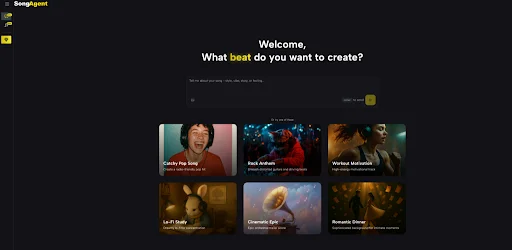
If you have ever searched for “the right background music” and ended up with 27 browser tabs, three half-finished drafts, and a vague feeling that none of it truly fits—this is for you. I ran into the same friction when I needed a track that felt specific (a mood, an arc, a sonic identity), not just “royalty-free and acceptable.” That is how I ended up testing SongAgent as an AI Song Agent—not as a magic button, but as a conversational collaborator that helps you translate intent (“warm, intimate, documentary-ready”) into something you can iterate on and export.
This article is not a sales pitch. Think of it as a guided tour of what an AI song agent can realistically do today, where it feels surprisingly useful, and where you should keep your expectations grounded.
- Why “finding music” feels harder than it should
- What an AI Song Agent is (and what it is not)
- How SongAgent works in practice
- Where this approach is genuinely helpful
- Feature comparison: what matters (and what is just noise)
- A realistic way to think about “quality”
- Licensing and practical compliance (don’t skip this)
- A simple prompt framework you can reuse
- External perspective: AI music is improving, but trust is earned
- Bottom line: treat it like a collaborator, not a shortcut
Why “finding music” feels harder than it should
Most creators do not struggle because they lack taste. They struggle because music selection is a multi-variable problem:
- You need the right emotion, not just the right genre.
- You need the right structure (intro, build, chorus, drop) to match your edit or narrative.
- You need the right texture (instrument choices, density, brightness) so the music supports, not competes.
Traditional approaches can work, but they are often slow and fragmented—especially when you need speed, consistency, and repeatability across a series of videos or a brand.
What an AI Song Agent is (and what it is not)
An AI song agent is best understood as a workflow layer between your creative intent and the final audio output.
It is not merely “generate a random track.” At its best, it behaves like a junior producer who:
- asks for clarity (directly or implicitly),
- proposes a plan,
- generates a draft,
- and then responds to feedback in a structured loop
With SongAgent, that “plan-first” approach is visible in its blueprint-style flow (describe → review a musical plan → generate → refine → download), which—based on my own testing—reduces the feeling of throwing prompts into a black box and hoping for the best.
How SongAgent works in practice
1) You describe intent, not parameters
You can write like a human. For example:
- “Uplifting acoustic folk for a travel documentary; warm vocals; hopeful chorus.”
- “Minimal ambient bed for a product demo; no distracting melody; steady pulse.
In my tests, the most productive prompts were the ones that included use-case (where it will be used) plus emotion (what it should make people feel). Technical details helped, but they were not mandatory.
2) You review a “musical blueprint” before committing
This is the part I did not expect to care about—but it matters.
A blueprint step is essentially a sanity check: structure, instrumentation, key/tempo, and stylistic direction are presented before the full generation. That means you can catch misunderstandings early (“this should be sparse, not cinematic”), rather than after you have already generated something that is directionally wrong.
3) You iterate via conversation (not restarting from scratch)
A good music draft rarely arrives in one shot. The “agent” idea is most valuable when the tool lets you refine without rewriting everything.
In my experience, the most reliable iteration requests sounded like a producer’s notes:
- “Make the chorus lift more—add energy without increasing loudness too much.”
- “Less vocal presence; keep it supportive for narration.”
- “Add a bridge with a different texture, then return to the main motif.”
4) You export for real-world workflows
For creators, export options can matter more than the first draft. SongAgent highlights output options like MP3/WAV, vocal separation, and stems (multi-track exports). If you do any real editing—cutting to picture, mixing under voiceover, or layering sound design—stems can be the difference between “usable” and “stuck.”
Where this approach is genuinely helpful
Speed without defaulting to generic
The usual tradeoff is speed versus specificity. Searching libraries is fast, but often feels “close enough.” Commissioning a composer is specific, but rarely fast.
An AI song agent sits between those extremes. The “agent” part—blueprint + iterative refinement—makes it easier to converge on something tailored without needing a full production pipeline.
Consistency across a series
If you are producing episodic content (a channel, a podcast, a brand series), consistency is the hidden challenge. In my testing, I found it easier to keep a coherent sonic identity by reusing a prompt framework (“same palette, new melody arc”) and iterating from there.
Feature comparison: what matters (and what is just noise)
Below is a pragmatic comparison table—less about hype, more about workflow fit.
| Comparison Item | Song Agent | Typical AI Music Generator (one-shot focus) | Stock/royalty-free libraries | Hiring a composer/producer |
| Creative input style | Conversational prompts + iterative refinement | Prompt → generate → restart | Browse tags, moods, playlists | Briefing + feedback cycles |
| “Plan before generate” | Musical blueprint review | Often not explicit | Not applicable | Yes (creative brief / references) |
| Iteration speed | Fast, guided by dialogue | Medium; may require rerolls | Slow if you cannot find the match | Slowest (but most bespoke) |
| Consistency across a series | Strong if you reuse frameworks | Mixed | Mixed | Strong |
| Exports for production | WAV + stems + separation (where available in plan) | Varies by tool | Usually stereo master only | Full stems if agreed |
| Licensing clarity | Tiered (personal vs commercial depending on plan) | Varies widely | Often clear per track | Contract-based |
| Best for | Content creators, rapid prototyping, brand series | Experiments, quick drafts | Safe background beds | Signature sound, high-stakes releases |
A realistic way to think about “quality”
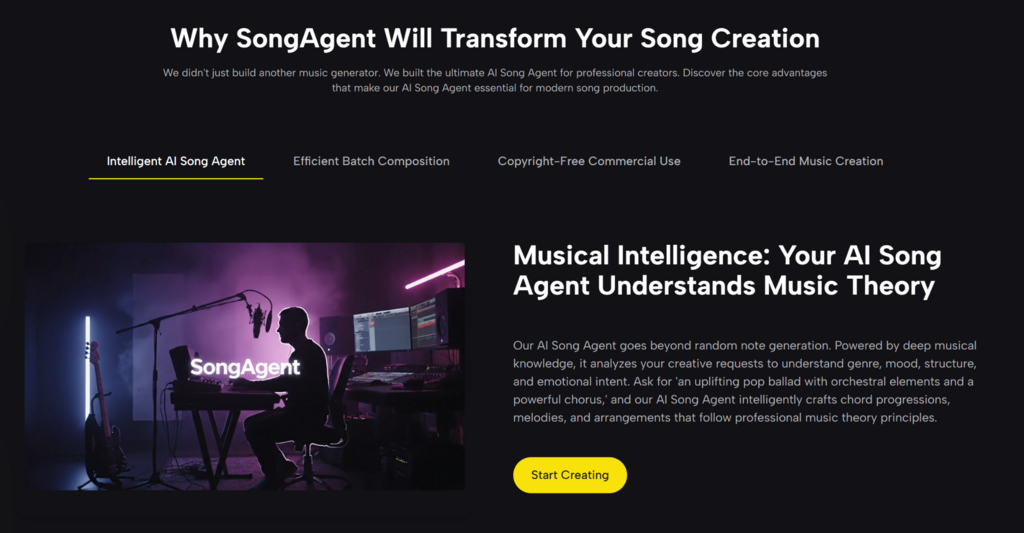
What sounded “better than expected” in my testing
In my own runs, the output felt most stable when I:
- asked for a clear emotional arc (calm intro → lift → resolved ending),
- kept instrumentation modest,
- and iterated with specific notes rather than “make it better.
The overall impression was that the tool is more reliable as a structured co-creator than as an oracle that produces perfection on the first try.
Where you should stay cautious
Even strong generations can have friction points:
- Prompt sensitivity: vague prompts often yield generic results.
- Variation across runs: two “similar” prompts can drift more than you expect.
- Vocal artifacts (when vocals are involved): you may need multiple generations or post-processing to reach “release-ready.”
- Mix fit under voiceover: a track can be “good” but still clash with narration—stems help, but you still need judgement.
These are not deal-breakers; they are reminders that you are still the creative director.
Licensing and practical compliance (don’t skip this)
If you plan to publish commercially (ads, paid content, monetized channels, client work), treat licensing as a checklist item—not a footnote.
SongAgent presents commercial use as tied to paid tiers (with free usage framed as personal). Regardless of the tool you use, you should archive:
- the plan/tier you were on,
- the timestamp of generation,
- and any licensing statements provided in-product.
This is not about fear; it is about professional hygiene.
A simple prompt framework you can reuse
Here is a prompt structure that worked well for me:
- Use-case: “background for X (travel vlog / product demo / podcast intro)”
- Emotion: “warm / tense / playful / uplifting”
- Structure: “short intro, clear hook, softer bridge, resolved ending”
- Instrumentation: “acoustic guitar + light percussion + subtle pads”
- Constraints: “avoid busy melody under narration; keep dynamics controlled”
Small changes to one line (emotion or instrumentation) can produce meaningful variety while keeping brand consistency.
External perspective: AI music is improving, but trust is earned
If you want a neutral view of the broader AI-music landscape—benefits, headwinds, and adoption realities—MIDiA Research has discussed AI music creation in 2025 in a way that is more analytical than promotional:
- Further reading: Beyond the hype: AI music creation in 2025 — https://www.midiaresearch.com/reports/beyond-the-hype-ai-music-creation-in-2025
Bottom line: treat it like a collaborator, not a shortcut
If you want a tool that helps you move from “I know what I want it to feel like” to “I have a usable track I can iterate on,” SongAgent as an AI Song Agent is a practical workflow to try—especially because the blueprint + refinement loop aligns with how music is actually made: draft, listen, adjust, repeat.
Just keep the mindset grounded:
- you may need multiple generations,
- you may need edits or stems to fit your final context,
- and your prompt quality matters more than you think.
Used that way, an AI song agent is not replacing taste. It is compressing the distance between your taste and your output.